
when are delineators effective guides
Delineators excel at guiding motorists, especially near hazards or construction, offering superior lighting for accident prevention. They’re vital for safe traffic flow.
A. Defining Traffic Delineators
Traffic delineators are specialized safety devices strategically deployed to guide traffic flow and alert drivers to potential hazards. These aren’t simply markers; they’re proactive safety tools, particularly effective in scenarios demanding clear directional guidance. Worksafe Traffic Control highlights their “superior lighting capability” in preventing accidents, showcasing their value.
Crowd Control Warehouse emphasizes their use for “effective traffic guidance, lane separation, and hazard identification,” spanning highways, parking lots, and airports. Delineators, like FlexStake posts, are designed for impact resistance, springing back upright, ensuring continuous guidance even after incidental contact. They are a cornerstone of modern traffic management systems.
B. Importance of Effective Guidance Systems
Effective guidance systems are paramount for minimizing accidents and optimizing traffic flow, and delineators play a crucial role within these systems. Their ability to proactively alert motorists to hazards, as noted by Worksafe Traffic Control, significantly reduces risk. Clear directional cues, especially in dynamic environments like work zones, are essential for driver safety.
Crowd Control Warehouse highlights delineators’ value in “lane separation” and “hazard identification,” contributing to orderly traffic. The reflective properties and bright colors ensure visibility, even in low-light conditions, bolstering system effectiveness. A well-defined guidance system, incorporating delineators, is a cornerstone of safe roadways.
C. Scope of the Article: When Delineators Excel
This article focuses on scenarios where traffic delineators prove most effective as guidance tools. We’ll explore their utility in work zones and construction sites, where hazard alerting is critical, as emphasized by Worksafe Traffic Control. Further, we’ll examine their role in highway merges, diverges, and parking lot traffic management.
Crowd Control Warehouse points to airports as key locations, highlighting their use on taxiways and aprons. We’ll analyze placement strategies and reflectivity considerations, ensuring optimal performance. Ultimately, this exploration will demonstrate delineators’ versatility in enhancing safety and order across diverse environments.

II. Understanding the Core Functionality of Delineators
Delineators effectively guide drivers by providing visual cues, alerting them to potential hazards, and maintaining organized lane separation for safer traffic flow.
A. Visual Guidance: How Delineators Direct Drivers
Delineators provide crucial visual guidance, particularly effective in scenarios demanding clear directional cues for motorists. Their strategic placement actively directs drivers, especially around work zones and highway merges;
These posts, often featuring reflective bands, enhance visibility, ensuring drivers can easily follow designated paths, even in low-light conditions. FlexStake delineators, designed to flex upon impact and self-right, maintain continuous guidance.
This consistent visual pathway minimizes confusion and promotes a smoother, safer traffic flow, reducing the risk of accidents caused by uncertainty or misdirection. They are a proactive safety measure.
B. Hazard Alerting: Proactive Safety Measures
Delineators function as proactive safety measures by effectively alerting motorists to potential hazards ahead. Their presence signals changes in road conditions, construction zones, or areas requiring reduced speed and increased caution.
The superior lighting capability of these devices, particularly reflective bands, ensures high visibility, even during nighttime or inclement weather. This early warning system allows drivers to react appropriately, minimizing the risk of collisions.
Strategic placement directs drivers away from dangers, creating a safer environment for both workers and traveling public, proving their value in temporary traffic control.
C. Lane Separation: Maintaining Order in Traffic Flow
Delineators are remarkably effective in maintaining order within traffic flow by clearly separating lanes, especially in areas like highway merges, diverges, and work zones. They provide a visual guide, preventing accidental lane drifting and reducing congestion.
FlexStake delineator posts, designed to flex upon impact and self-right, are ideal for these dynamic environments. Their easy deployment and repositioning allow for quick adjustments to traffic patterns as needed.
This clear lane definition enhances safety and efficiency, ensuring a smoother and more predictable driving experience for all motorists.

III. Types of Traffic Delineators and Their Characteristics
Various delineators – flexible posts, rigid posts, and weighted bases – offer diverse solutions for traffic guidance, hazard identification, and lane separation needs.
A. Flexible Delineator Posts (FlexStake)
FlexStake delineator posts represent a highly adaptable solution for traffic management, proving particularly effective in dynamic environments like work zones, highways, and parking areas. Their defining characteristic – the ability to flex upon impact and swiftly return to an upright position – minimizes damage to both the delineator and passing vehicles.
This resilience makes them ideal for situations where accidental contact is probable. Crowd Control Warehouse highlights their utility in guiding traffic, separating lanes, and clearly identifying potential hazards. The reflective bands enhance visibility, ensuring effectiveness even in low-light conditions, contributing significantly to overall road safety.
B. Rigid Delineator Posts
Rigid delineator posts offer a robust alternative to flexible options, best suited for environments demanding a more permanent and assertive traffic guidance system. While lacking the impact-absorbing quality of FlexStake posts, their inherent stability provides a clear and unwavering visual cue for drivers.
These posts are particularly effective in scenarios where consistent lane definition is crucial, such as highway merges or diverges, and areas requiring a strong visual barrier. Equipped with reflective bands, they maintain visibility during nighttime or adverse weather, ensuring continued effectiveness in directing traffic flow and enhancing road safety.
C. Delineators with Weighted Bases
Delineators featuring weighted bases provide enhanced stability, making them ideal for locations prone to strong winds or accidental impacts. Their added weight resists displacement, ensuring consistent and reliable guidance for motorists. These are particularly effective in temporary traffic control zones like construction sites and parking lots, where frequent repositioning is necessary.
The ease of transport and deployment, combined with their robust design, makes them a critical component of any traffic management system. Reflective bands guarantee visibility in low-light conditions, bolstering safety and directing traffic effectively, day or night.
D. Reflective Band Materials & Visibility
Reflective band materials are paramount to delineator effectiveness, especially during periods of low light or inclement weather. High-contrast colors enhance daytime visibility, while retroreflective sheeting ensures drivers can easily identify traffic patterns at night. These materials meet specific reflectivity standards, guaranteeing a consistent level of performance.
The superior lighting capability of delineators significantly reduces accident risks by proactively alerting motorists to hazards. Maintaining reflectivity over time is crucial; regular inspection and replacement ensure continued guidance and safety for all road users.

IV. Environmental Factors Affecting Delineator Effectiveness
Visibility is impacted by lighting, rain, snow, and fog; delineators must remain conspicuous in all conditions to effectively guide drivers and ensure safety.
A. Lighting Conditions: Daytime vs. Nighttime
Delineator effectiveness dramatically shifts with ambient light. During daylight, bright, high-contrast colors are crucial for visibility, allowing drivers to easily perceive guidance. However, nighttime presents a significant challenge. This is where retroreflectivity becomes paramount; delineators must actively reflect headlights back towards drivers.
Superior lighting capability, as noted by traffic control experts, is key to preventing accidents. Reflective band materials are therefore essential, ensuring delineators remain conspicuous even in complete darkness. Maintaining this reflectivity over time is vital for consistent performance, regardless of the hour.
B. Weather Impact: Rain, Snow, Fog
Delineator performance is significantly impacted by adverse weather. Rain and snow can reduce visibility, diminishing the effectiveness of both color and reflectivity. Fog presents an even greater challenge, scattering light and severely limiting sight distances. Therefore, high-quality reflective materials are crucial, maximizing headlight return even in dense conditions.
Maintaining clear road surfaces around delineators is also important. Snow accumulation or standing water can obscure the posts, rendering them less noticeable. Regular inspection and repositioning may be necessary to ensure continued guidance during inclement weather, bolstering safety.
C. Road Surface & Visibility
Delineator effectiveness hinges on clear visibility against the road surface. Contrasting colors are vital during daylight, while retroreflective materials become paramount at night. A dirty or obscured road surface diminishes a delineator’s impact, reducing driver reaction time. Pavement markings work synergistically with delineators, reinforcing guidance.
Road conditions, like potholes or uneven surfaces, can also affect perception. Drivers focused on avoiding road damage may overlook delineators. Consistent placement and maintenance are key, ensuring they remain a prominent visual cue, especially in areas with compromised road quality, promoting safer navigation.

V. Situations Where Delineators are Highly Effective
Delineators shine in work zones, highway merges, parking lots, and airport taxiways, providing crucial guidance and hazard alerts for safer traffic control.
A. Work Zones & Construction Sites
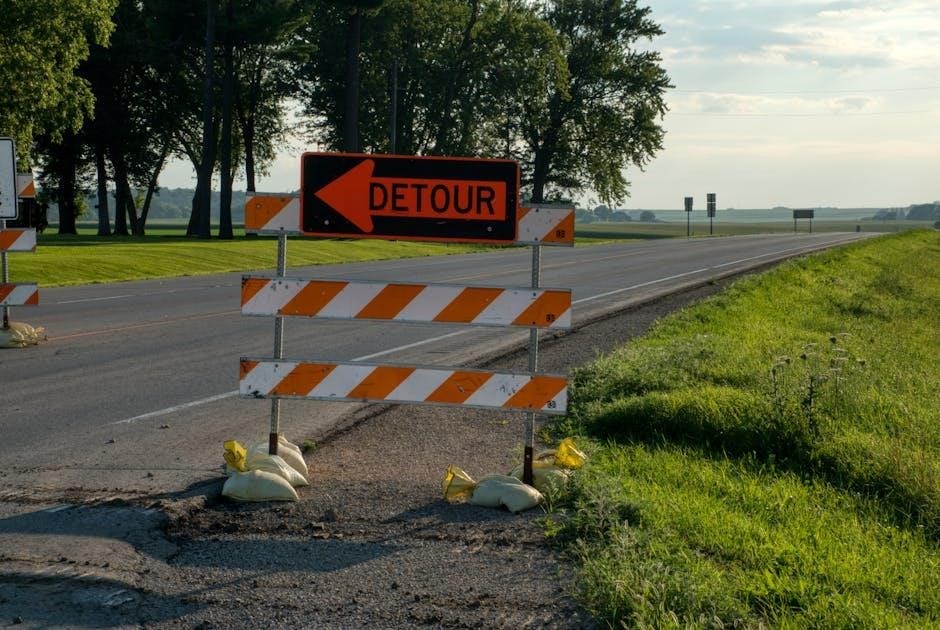
Delineators are exceptionally effective within work zones and construction sites, where dynamic traffic patterns and potential hazards demand clear, immediate guidance for motorists. Their flexibility—like the FlexStake design—is crucial, absorbing impact and quickly returning to an upright position, minimizing damage and disruption.
These posts, often featuring highly reflective bands, dramatically enhance visibility, particularly during low-light conditions, alerting drivers to lane shifts, reduced speeds, and the presence of workers. Strategic placement creates temporary, yet robust, traffic flow patterns, safeguarding both construction personnel and passing vehicles; They are a cornerstone of temporary traffic control plans.
B. Highway Merges & Diverges
Delineators prove invaluable at highway merges and diverges, providing crucial guidance where traffic flow is inherently complex and prone to congestion. Their ability to clearly define lane transitions and direct vehicles into the correct pathways significantly reduces the risk of collisions.
The reflective properties of delineator posts, especially during nighttime or inclement weather, are paramount in ensuring drivers maintain awareness of the roadway alignment. Properly spaced delineators facilitate smoother merging and diverging maneuvers, minimizing abrupt lane changes and promoting a more orderly traffic stream, enhancing overall highway safety.
C. Parking Lot Traffic Flow
Delineators are remarkably effective in managing parking lot traffic, creating clear pathways for vehicles and pedestrians alike. They define driving lanes, direct traffic around obstacles, and delineate parking spaces, preventing confusion and potential accidents. Their ease of deployment and repositioning makes them ideal for dynamic parking environments.
The bright, high-contrast colors and reflective bands enhance visibility, particularly during low-light conditions, guiding drivers safely through the lot. Flexible delineator posts, like FlexStake, absorb impact, minimizing damage and ensuring continued functionality, contributing to a more organized and secure parking experience.
D. Airport Taxiways & Aprons
Delineators play a crucial role in airport ground operations, effectively guiding aircraft and vehicles along taxiways and aprons. They clearly define movement areas, enhancing situational awareness for pilots and ground crew, and minimizing the risk of runway incursions – a significant safety concern.
Their high visibility, achieved through reflective materials, is paramount, especially during nighttime or adverse weather conditions. Flexible posts, designed to withstand impacts from aircraft, are preferred, ensuring continued guidance even after accidental contact. Strategic placement supports safe and efficient airport ground traffic flow.

VI. Delineator Placement Strategies for Maximum Impact
Effective placement, utilizing proper spacing and alignment, guides drivers through curves and emphasizes hazards, maximizing their impact on traffic control.
A. Spacing & Alignment Principles
Strategic delineator spacing is crucial for effective guidance. Closer spacing creates a stronger visual cue, ideal for sharper curves or areas demanding increased driver attention, like work zones. Conversely, wider spacing suits gentler curves and open stretches, providing sufficient direction without visual clutter.
Alignment must be consistent and logical, mirroring the intended path of travel. Properly aligned delineators intuitively guide drivers, reducing hesitation and promoting smooth traffic flow. Misalignment can cause confusion and potentially negate their safety benefits. Easy transport and repositioning are key to maintaining optimal alignment as conditions change.
B. Utilizing Delineators for Curve Negotiation
Delineators are exceptionally effective on curves, providing a clear visual path for drivers. Placing them on the inside of curves emphasizes the turning radius, while exterior placement highlights the road’s edge. Closer spacing on sharper curves reinforces the need for reduced speed and careful steering.
Consistent alignment is paramount; drivers instinctively follow the delineator line. Their superior lighting capability, especially with reflective bands, is vital for nighttime visibility. FlexStake posts, designed to flex and return upright, minimize damage and maintain guidance even after impact, ensuring continued safety.
C. Strategic Placement for Hazard Emphasis
Delineators proactively alert motorists to potential dangers, proving very effective in hazard zones. Concentrated placement before obstructions – like construction areas or lane closures – immediately draws attention. Offset arrangements can create a ‘channeling’ effect, guiding drivers safely around the hazard.
Utilizing bright, high-contrast colors alongside reflective bands maximizes visibility, day or night. FlexStake posts are ideal, absorbing impact and maintaining their guiding function. This strategic deployment minimizes the risk of accidents, enhancing overall traffic control and work zone safety for everyone involved.

VII. The Role of Reflectivity in Delineator Performance
Reflectivity is crucial; delineators with reflective bands ensure visibility in low-light, enhancing nighttime guidance and significantly improving driver awareness and safety.
A. Retroreflectivity Standards & Ratings
Retroreflectivity, the ability to return light towards its source, is paramount for delineator effectiveness, particularly at night and in adverse weather. Standards, like those set by ASTM, dictate minimum reflectivity levels. These ratings—measured in candelas per lux per square meter (cd/lx/m²) – ensure consistent visibility.
Higher ratings signify brighter reflection, crucial for quick hazard identification. Delineators must meet specific standards based on their application; highway delineators require greater retroreflectivity than those used in parking lots. Maintaining these standards through regular inspection and timely replacement of faded materials is essential for optimal performance and continued safety benefits for motorists.
B. Types of Reflective Materials Used
Various reflective materials enhance delineator visibility. Engineer-grade prismatic sheeting offers good reflectivity for general applications like parking areas. High-intensity prismatic sheeting provides superior brightness for highways and work zones, crucial for nighttime hazard alerting.
Diamond Grade reflective sheeting delivers the highest level of retroreflection, ideal for complex highway configurations. Adhesive films and reflective bands are commonly applied to delineator posts. The choice depends on the required visibility, environmental conditions, and budget. Bright, high-contrast colors further improve daytime effectiveness, complementing the reflective properties.
C. Maintaining Reflectivity Over Time
Consistent reflectivity is paramount for delineator effectiveness. Dirt, grime, and weathering diminish retroreflection, reducing nighttime visibility. Regular cleaning with mild detergent and water restores performance. Inspect delineators frequently for damage – cracks or fading significantly lower reflectivity.
Proactive replacement of worn or damaged units ensures continued safety. Consider applying a protective coating to shield reflective materials from UV degradation. Scheduled maintenance programs, including reflectivity checks, are vital for maintaining optimal guidance and hazard alerting capabilities, especially in high-traffic areas.

VIII. Impact Resistance and Durability Considerations
FlexStake posts are designed to flex upon impact and self-right, offering a balance between resilience and longevity for effective traffic control.
A. Flexing vs. Breaking: The Trade-offs
Flexible delineator posts, like FlexStake, present a crucial design trade-off. Their ability to bend and recover from impacts, rather than fracturing, minimizes damage and reduces replacement costs, ensuring continuous guidance.
However, this flexibility inherently means they may not offer the same level of robust barrier protection as rigid posts. While effective at alerting drivers and channeling traffic, they won’t physically stop a vehicle with significant force.
The choice depends on the application; high-speed areas benefit from the continuous visibility of flexing posts, while areas needing a stronger physical barrier might require rigid alternatives.
B. Material Selection for Longevity
Delineator longevity hinges on material choice. Durable plastics, resistant to cracking and UV degradation, are essential for sustained performance, particularly in harsh weather conditions. The base material must withstand repeated impacts and maintain stability.
Reflective band adhesion is also critical; a secure bond ensures consistent nighttime visibility. Considering the deployment environment – highways versus parking lots – dictates the required robustness.
Investing in higher-quality materials reduces lifecycle costs through fewer replacements, maintaining effective traffic guidance and hazard alerting over extended periods.
C. Assessing Damage & Replacement Protocols
Regular inspection is crucial for maintaining delineator effectiveness. Damage assessment should focus on base stability, post integrity (flexing vs. breaking), and reflective band visibility. Cracked or broken posts, or those failing to return upright after impact, require immediate replacement.
Protocols should define frequency of checks – weekly in high-traffic areas, monthly elsewhere. Documenting damage aids in identifying recurring issues and informs future material selection.
Prompt replacement ensures continuous hazard alerting and guidance, preventing accidents and maintaining safe traffic flow, especially in work zones.
IX. Delineators and Air Traffic Control (Brief Mention)
Delineators show potential for enhancing airport ground operations, aiding in runway incursion prevention by clearly marking taxiways and aprons for pilots.
A. Potential Applications in Airport Ground Operations
Delineators offer significant benefits within airport environments, particularly in enhancing ground safety and operational efficiency. Their application extends to clearly marking taxiway edges, guiding aircraft movements during low-visibility conditions, and defining pedestrian walkways. The reflective properties of delineators, crucial for nighttime visibility, are especially valuable on aprons and taxiways.
Furthermore, they can delineate temporary closures or construction zones, ensuring ground personnel and aircraft avoid hazardous areas. FlexStake delineators, designed to withstand impacts and self-right, are ideal for this dynamic environment. By improving situational awareness for pilots and ground crews, delineators contribute to a safer and more organized airport landscape, potentially reducing runway incursions.
B. Relevance to Preventing Runway Incursions
Delineators play a crucial role in mitigating runway incursions by providing clear, visual guidance for both pilots and ground vehicles. Strategically placed, they define operational boundaries, highlighting taxiway and runway edges, especially during periods of reduced visibility. Their reflective bands enhance nighttime conspicuity, ensuring clear demarcation even in challenging conditions.
The use of flexible delineators minimizes damage from accidental impacts, maintaining continuous guidance. By reinforcing visual cues and reducing ambiguity, delineators help prevent unauthorized entry onto active runways. This proactive approach to runway safety, combined with other traffic control measures, significantly lowers the risk of potentially catastrophic incidents.

X. Complementary Traffic Control Devices & Delineators
Delineators work best alongside signage and road markings, creating a comprehensive guidance system for drivers, enhancing safety and clarity on roadways.
A. Combining Delineators with Signage
Delineators significantly amplify the effectiveness of traffic signage, particularly in challenging conditions like work zones or during nighttime driving. Signage provides crucial informational warnings, while delineators offer continuous, visual guidance, reinforcing the message. This combination is especially valuable when directing drivers around hazards or through lane shifts.
Strategically placed delineators leading up to and following a sign ensure drivers understand and react appropriately to the information presented. They create a clear path, minimizing confusion and enhancing overall road safety. The synergy between these devices provides a robust traffic control solution, exceeding the capabilities of either method alone.
B. Integrating with Road Markings
Delineators work exceptionally well when integrated with existing road markings, creating a layered guidance system for drivers. Road markings establish the fundamental lane structure, while delineators provide temporary or supplemental guidance, particularly useful in construction or maintenance areas. This combination enhances visibility, especially during inclement weather or low-light conditions.
Delineators can reinforce lane closures indicated by markings, or highlight temporary lane shifts. They effectively channel traffic, ensuring drivers stay within designated pathways. This integrated approach maximizes clarity and minimizes the risk of accidents, offering a comprehensive solution for traffic management and improved road safety for all motorists.
C. Utilizing Delineators with Traffic Cones
Delineators and traffic cones form a powerful duo for effective traffic control, particularly in dynamic work zones. Cones establish a broad perimeter, alerting drivers to potential hazards, while delineators offer more precise directional guidance within that zone. This combination is especially valuable during nighttime or low-visibility conditions, leveraging the superior reflective capabilities of both devices.
Strategically placed delineators can channel traffic through a cone-defined area, minimizing confusion and promoting a smoother flow. They reinforce the message conveyed by the cones, reducing the likelihood of drivers inadvertently entering restricted areas, ultimately enhancing safety for both workers and the traveling public.